AI + IoT Workforce, Asset &
Operations Intelligence for
Underground Mining.
Continuous underground intelligence across workforce, shaft access, mobile fleet, inventory, ore haulage and mineral traceability — purpose-built for the operational realities below surface.
AI + IoT Purpose-Built for Underground Mining
Underground mining presents one of the most operationally demanding industrial environments. Complex tunnel networks, shaft systems, production drifts, declines, crosscuts, stopes, ore passes, loading pockets, ventilation raises, refuge chambers, and restricted communication conditions make real-time operational visibility significantly more challenging than in surface mining operations.
Traditional operational management often depends on radio communication, manual inspections, paper-based reporting, isolated monitoring systems, and delayed production updates. These limitations reduce situational awareness and make it difficult to optimize workforce deployment, equipment utilization, material movement, inventory availability, and emergency response.
UndergroundMine AI delivers enterprise AI + IoT solutions developed specifically for underground mining operations — focused on the operational priorities that matter most underground: workforce intelligence, secure shaft access, mobile equipment visibility, underground inventory management, ore haulage monitoring, and mineral traceability.
Artificial intelligence continuously processes operational data collected from RFID, BLE beacons, UWB positioning, RTLS, LoRaWAN gateways, Private LTE, industrial Wi-Fi, AI vision cameras, environmental sensors and edge computing devices — enabling mine operators to improve safety, reduce delays and make faster decisions across the mining cycle.
The solutions support underground gold, copper, nickel, zinc, silver, uranium, potash, coal, lithium hard rock, rare earth, and polymetallic mining operations while integrating with existing mine planning, production, maintenance, and safety systems.
The solutions support underground gold, copper, nickel, zinc, silver, uranium, potash, coal, lithium hard rock, rare earth, and polymetallic mining operations while integrating with existing mine planning, production, maintenance, and safety systems.
How AI + IoT Is Transforming Underground Mining
Every production shift generates thousands of operational events involving personnel movement, equipment utilization, blasting preparation, drilling activities, mucking operations, ore transportation, ventilation management, maintenance work, inventory consumption, and contractor activities.
Without continuous digital visibility, mine supervisors often rely on delayed operational reports and manual communication, making it difficult to respond quickly to changing underground conditions.
AI + IoT transforms underground mining by continuously collecting, analyzing, and correlating operational data from workers, production equipment, underground infrastructure, environmental monitoring systems, and enterprise software.
Artificial intelligence identifies trends, predicts equipment failures, detects abnormal operating conditions, recognizes workforce safety risks, and recommends corrective actions before operational disruptions occur.
Operational improvements include
- Real time underground personnel visibility
- Faster emergency evacuation coordination
- Intelligent lone worker protection
- Automated shaft access authorization
- Continuous underground fleet visibility
- Improved LHD and haul truck utilization
- Faster equipment location
- Better development heading coordination
- Smarter spare parts inventory planning
- Automated explosives inventory management
- Improved ore haulage monitoring
- Digital production reporting
- Enhanced maintenance planning
- Reduced operational downtime
- Improved ventilation awareness
- Better contractor accountability
- Increased regulatory compliance
- Enhanced operational decision support
These improvements help mining organizations increase production efficiency while maintaining high standards of worker safety and operational governance.
Core AI Functions for Underground Mining
UndergroundMine AI prioritizes AI + IoT capabilities according to the operational requirements most critical to underground mining environments. Workforce safety and controlled underground access receive the highest priority, followed by asset visibility and inventory intelligence. Ore movement and mineral traceability provide additional operational optimization without distracting from the core operational objectives.
Mine Workforce Intelligence
Maintaining continuous awareness of personnel locations is essential for safe underground mining. AI analyzes workforce information collected through RFID identification, BLE positioning, RTLS, UWB localization, smart PPE, environmental sensors, and production activity records to provide accurate operational awareness across underground workings.
- Underground Miner Location Intelligence
- Production Shift Workforce Analytics
- Lone Miner Protection
- Mine Evacuation Intelligence
- Digital mustering
- Shift attendance verification
- Underground worker accountability
- PPE compliance monitoring
- Workforce density analysis
- Fatigue exposure reporting
- Restricted work area monitoring
- Historical personnel movement analysis
These capabilities help mine supervisors quickly locate personnel during normal operations, production changes, maintenance activities, and emergency situations while supporting compliance with mining safety regulations.
Shaft Access Intelligence
Every underground access point represents a critical safety and security checkpoint. AI continuously evaluates worker identity, certifications, shift assignments, contractor authorization, visitor credentials, work permits, and restricted-area permissions before granting access to underground workings.
- Mine Shaft Entry Authorization
- Underground Zone Intelligence
- Contractor Mine Access Analytics
- Mine Evacuation Intelligence
- Cage access verification
- Restricted drift monitoring
- Digital permit validation
- Underground access history
- Emergency lockdown management
- Compliance audit reporting
- Unauthorized entry detection
- Temporary work zone authorization
Automated access intelligence reduces human error, strengthens underground security, and provides complete digital audit trails for operational governance.
Underground Mine Asset Intelligence
Underground production depends on reliable availability of mobile and fixed mining assets. AI continuously analyzes equipment location, utilization, movement history, operating hours, maintenance records, and production assignments to improve equipment performance.
- Load Haul Dump (LHD) loaders
- Underground haul trucks
- Jumbo drill rigs
- Roof bolters
- Scaling machines
- Shotcrete equipment
- Utility vehicles
- Locomotives
- Conveyors
- Crushers
- Dewatering pumps
- Ventilation fans
- Compressors
- Transformers
- Portable maintenance equipment
These capabilities help mine supervisors quickly locate personnel during normal operations, production changes, maintenance activities, and emergency situations while supporting compliance with mining safety regulations.
Mine Inventory Intelligence
Continuous production depends on the timely availability of spare parts, consumables, maintenance materials, drilling supplies, electrical components, hydraulic equipment, PPE, lubricants, blasting accessories, and warehouse inventory.AI continuously evaluates inventory movement throughout warehouses, underground storage facilities, maintenance workshops, and production levels to optimize inventory availability while reducing excess stock.
- Underground Miner Location Intelligence
- Mine Consumables Intelligence
- Explosives Magazine Analytics
- Mine Warehouse Replenishment Intelligence
- Automated stock reconciliation
- Inventory utilization analysis
- Critical spare forecasting
- Material movement visibility
- Digital warehouse auditing
- Maintenance inventory planning
- Warehouse demand forecasting
- Inventory exception reporting
Intelligent inventory management minimizes production interruptions while improving procurement planning and reducing inventory carrying costs.
These improvements help mining organizations increase production efficiency while maintaining high standards of worker safety and operational governance.
AI + IoT Software for Underground Mining Operations
Underground mining generates continuous streams of operational data from personnel, mobile equipment, fixed infrastructure, production activities, maintenance operations, environmental monitoring systems, and underground communications. Converting this data into operational intelligence requires software specifically engineered for underground mining rather than generic industrial monitoring applications.
UndergroundMine AI delivers AI + IoT software designed for underground mining operations, enabling mine managers, production supervisors, maintenance planners, ventilation engineers, EHS professionals, control room operators, and digital transformation teams to monitor underground activities in real time. AI continuously analyzes operational events, identifies abnormal conditions, predicts emerging risks, and recommends corrective actions that improve safety, productivity, equipment utilization, and regulatory compliance.
The software supports underground hard rock mines, coal mines, potash operations, salt mines, precious metal mines, base metal mines, uranium mines, and critical mineral extraction sites while integrating with existing operational systems.
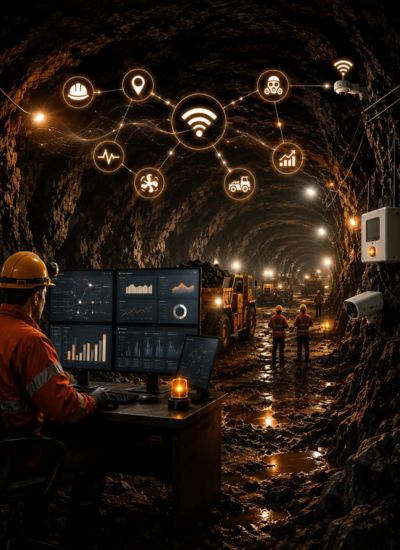
Maintaining continuous visibility of underground personnel is essential for operational safety and emergency preparedness. Workforce software collects information from RFID smart cards, BLE wearables, UWB positioning anchors, RTLS infrastructure, AI vision systems, environmental sensors, and underground communication networks to create a continuously updated view of workforce activities.
Unlike traditional attendance systems, the software continuously monitors workforce movement throughout shafts, cage stations, declines, production drifts, crosscuts, stopes, loading pockets, maintenance workshops, refuge chambers, ventilation stations, and underground substations.
Core software capabilities include:
- Underground Personnel Tracking Software
- Miner Safety Monitoring Software
- Workforce Compliance Software
- Mine Emergency Response Software
- Digital shift attendance
- Underground personnel localization
- Workforce density analysis
- Lone worker monitoring
- Fatigue exposure reporting
- Emergency mustering
- Refuge chamber occupancy monitoring
- Workforce productivity analytics
- Digital incident reporting
- Underground evacuation management
AI algorithms analyze workforce movement patterns to identify unusual behavior, detect prolonged inactivity, recognize unauthorized entry into hazardous areas, and generate alerts when immediate intervention may be required.
Controlling access to underground workings is fundamental to mine safety and operational governance. AI-enabled entry software verifies personnel identity, competency certifications, medical clearance, contractor authorization, work permits, shift assignments, and restricted-area permissions before granting access through shaft stations, decline portals, and controlled underground zones.
The software supports:
- Shaft Entry Authorization Software
- Underground Zone Access Software
- Mine Visitor Management Software
- Contractor Mine Access Software
- Cage access verification
- Digital permit validation
- Restricted drift authorization
- Explosives magazine access control
- Electrical room authorization
- Maintenance zone management
- Automated access logging
- Temporary access scheduling
- Visitor credential validation
- Emergency access override management
Every access event is recorded automatically, creating secure digital audit trails that simplify compliance reporting and improve operational accountability.
Underground mining relies on expensive production assets that must remain available throughout every production shift. AI + IoT equipment software continuously monitors equipment location, operating status, utilization, movement history, maintenance schedules, and production assignments.
Typical equipment monitored includes:
- Load Haul Dump (LHD) loaders
- Underground haul trucks
- Jumbo drill rigs
- Longhole drilling rigs
- Roof bolters
- Scaling machines
- Shotcrete equipment
- Explosives charging vehicles
- Portable welding equipment
- Utility vehicles
- Personnel carriers
- Underground locomotives
- Mobile compressors
- Dewatering pumps
- Ventilation fans
- Conveyor systems
- Crushers
- Mobile generators
Software modules include:
- Mobile Mining Equipment Tracking Software
- Underground Fleet Visibility Software
- Mining Tool Tracking Software
- Mine Equipment Utilization Software
- Fleet dispatch optimization
- Equipment idle analysis
- Maintenance scheduling
- Production asset allocation
- Operating hour monitoring
- Asset lifecycle reporting
AI evaluates production equipment performance using historical utilization, operating hours, maintenance records, idle periods, and movement patterns to optimize fleet productivity and reduce unnecessary downtime.
Reliable inventory availability is critical for uninterrupted mining operations. Missing spare parts, drilling consumables, hydraulic components, electrical equipment, PPE, blasting accessories, or maintenance tools can quickly delay production and increase operating costs.
AI continuously evaluates inventory consumption across central warehouses, underground storage facilities, maintenance shops, tool rooms, and production areas.
Core software capabilities include:
- Underground Spare Parts Software
- Explosives Magazine Software
- Mine Warehouse Inventory Software
- Mining Consumables Management Software
- Warehouse receiving management
- Underground inventory transfers
- Material issue management
- Critical spare forecasting
- Inventory reconciliation
- Warehouse optimization
- Digital stock auditing
- Material reservation management
- Procurement demand forecasting
- Inventory exception reporting
Machine learning models analyze historical inventory usage together with preventive maintenance schedules, equipment operating hours, seasonal production plans, and procurement lead times to improve inventory planning while reducing unnecessary stock.
AI Decision Intelligence for Underground Mining
Raw operational data provides limited value unless it can support better decisions. UndergroundMine AI applies artificial intelligence to continuously evaluate operational conditions, correlate multiple data sources, and identify patterns that are difficult to detect manually.
AI continuously processes information collected from RFID readers, BLE beacons, UWB positioning systems, environmental sensors, AI vision cameras, fleet telemetry, warehouse systems, and production databases.
Operational improvements include
- Predicting equipment failures before production interruptions
- Detecting abnormal workforce movement
- Identifying underground traffic congestion
- Forecasting inventory shortages
- Monitoring ventilation effectiveness
- Recognizing production bottlenecks
- Detecting unauthorized access attempts
- Optimizing LHD dispatch
- Improving haul truck routing
- Forecasting maintenance requirements
- Supporting production scheduling
- Identifying safety compliance exceptions
- Improving contractor coordination
- Optimizing shift workforce allocation
These AI-generated insights help operational teams respond proactively instead of reacting after production problems have already occurred.
Enterprise Software Connectivity
UndergroundMine AI integrates with existing operational systems to create a connected digital mining environment without requiring organizations to replace proven software investments.
Common enterprise integrations include
- Mine SCADA systems
- Fleet Management Systems (FMS)
- Computerized Maintenance Management Systems (CMMS)
- Enterprise Resource Planning (ERP)
- Warehouse Management Systems (WMS)
- Human Resource Information Systems (HRIS)
- Mine Planning Software
- Geological Modeling Software
- Laboratory Information Management Systems (LIMS)
- Production Reporting Systems
- Production Reporting Systems
- Mine Scheduling Software
- Business Intelligence tools
- Active Directory authentication services
Supported communication standards include
- REST API
- MQTT
- OPC UA
- Modbus TCP
- SQL databases
- Web services
- Secure file exchange
- Secure file exchange
- Edge synchronization
- Event streaming
- Message queuing
These integrations ensure operational information flows securely between underground systems, maintenance teams, production departments, engineering groups, warehouse operations, and executive management.
Operational Applications of Underground Mining Software
UndergroundMine AI software supports daily operations throughout the entire underground mining lifecycle, from mine development and production drilling to ore extraction, maintenance, logistics, and emergency response.
Key operational applications include
- Underground personnel safety monitoring
- Production shift workforce management
- Digital shaft access authorization
- Contractor and visitor management
- LHD fleet coordination
- Underground haul truck dispatch
- Jumbo drill utilization monitoring
- Mine tool room management
- Underground warehouse operations
- Spare parts inventory optimization
- Explosives magazine control
- Ore pass monitoring
- Drawpoint production visibility
- Mucking cycle analysis
- Conveyor system monitoring
- Ventilation management support
- Emergency evacuation coordination
- Maintenance planning
- Production reporting
- Regulatory compliance documentation
These AI-powered software solutions provide mining organizations with continuous operational visibility, helping improve workforce safety, production efficiency, equipment utilization, inventory accuracy, and decision-making across underground mining operations.
IoT Hardware Technologies for AI + IoT-Enabled Underground Mining
Reliable AI + IoT solutions depend on industrial-grade hardware capable of operating in demanding underground mining environments. Underground mines expose equipment to abrasive dust, high humidity, vibration, water ingress, temperature fluctuations, confined spaces, uneven terrain, and limited communication coverage. UndergroundMine AI supports ruggedized IoT hardware engineered for continuous operation under these challenging conditions while delivering accurate, real-time operational data.
The hardware portfolio combines RFID, BLE, UWB, RTLS, LoRaWAN, Private LTE, industrial Wi-Fi, AI vision systems, environmental sensing, and edge computing to provide continuous visibility into personnel, mobile equipment, fixed assets, inventories, underground infrastructure, and production activities.
These technologies support underground gold, copper, silver, nickel, zinc, lead, uranium, coal, potash, lithium hard rock, rare earth, diamond, and polymetallic mining operations.
Underground Sensing Devices
Industrial sensing devices provide the foundation for intelligent underground mining by collecting operational data from workers, machinery, infrastructure, storage facilities, and environmental systems.
- Smart Miner Tags
- Rugged Equipment Tags
- Mine Environment Sensors
- Underground Positioning Beacons
- RFID personnel identification tags
- BLE wearable safety badges
- UWB positioning anchors
- RTLS location sensors
- Gas detection sensors
- Dust monitoring sensors
- Temperature sensors
- Humidity sensors
- Airflow monitoring sensors
- Ventilation pressure sensors
- Water level sensors
- Ground vibration sensors
- Equipment vibration sensors
- Conveyor speed sensors
- Pump status sensors
- Electrical power monitoring sensors
Continuous sensing enables AI to evaluate operational conditions throughout production drifts, declines, crosscuts, shaft stations, loading pockets, ore passes, maintenance shops, refuge chambers, and underground substations.
Smart Miner Tags
Smart miner tags provide automatic identification and continuous location awareness without interrupting normal mining activities. Designed for harsh underground conditions, these devices are commonly integrated into mining helmets, cap lamps, safety badges, or wearable PPE.
- Real-time personnel identification
- Continuous underground positioning
- Shift attendance verification
- Digital mustering
- Lone worker monitoring
- Emergency evacuation support
- Restricted area detection
- Proximity awareness
- Workforce accountability
- Historical movement records
- Exposure duration analysis
- Emergency rescue support
AI analyzes movement history to identify abnormal behavior, prolonged inactivity, unauthorized entry into hazardous zones, and deviations from assigned work areas.
Rugged Equipment Tags
Mobile mining equipment represents one of the largest capital investments within underground operations. Rugged RFID and BLE asset tags provide continuous identification and tracking of both mobile and stationary assets while withstanding shock, vibration, dust, moisture, and frequent cleaning.
- Load Haul Dump (LHD) loaders
- Underground haul trucks
- Jumbo drill rigs
- Longhole drills
- Roof bolters
- Scaling machines
- Shotcrete sprayers
- Utility vehicles
- Personnel carriers
- Locomotives
- Conveyor drives
- Crushers
- Mobile compressors
- Dewatering pumps
- Ventilation fans
- Transformers
- Mobile substations
- Welding equipment
- Hydraulic power units
- Portable maintenance tools
Continuous asset visibility supports fleet dispatch, maintenance scheduling, utilization analysis, lifecycle management, and operational planning.
Mine Environment Sensors
Environmental monitoring is essential for maintaining safe working conditions throughout underground mining operations.
AI continuously analyzes measurements collected from intelligent environmental sensors, helping operators recognize hazardous conditions before they become safety incidents.
- Oxygen concentration
- Methane concentration
- Carbon monoxide
- Carbon dioxide
- Hydrogen sulfide
- Nitrogen dioxide
- Sulfur dioxide
- Air temperature
- Relative humidity
- Dust concentration
- Air velocity
- Ventilation pressure
- Water accumulation
- Ground movement
- Equipment vibration
- Electrical power quality
- Noise levels
Real-time monitoring supports ventilation management, emergency preparedness, regulatory compliance, and workforce protection.
Underground Positioning Technologies
Conventional GPS signals cannot penetrate underground rock formations. UndergroundMine AI supports multiple positioning technologies that deliver reliable location awareness throughout underground workings.
Positioning technologies include:
- BLE positioning
- UWB positioning
- RFID positioning
- RTLS
- Dead reckoning
- Inertial navigation
- Hybrid positioning algorithms
- Beacon-assisted localization
Applications include:
- Personnel localization
- Equipment tracking
- Underground vehicle positioning
- Emergency rescue coordination
- Refuge chamber navigation
- Traffic flow monitoring
- Production activity mapping
- Asset recovery
- Historical movement replay
- Operational heat mapping
Combining multiple positioning technologies improves location accuracy while maintaining operational reliability in complex underground environments.
Mine Vision Systems
AI-powered computer vision enables automated monitoring of underground operations without continuous human observation. Vision systems interpret live video streams to identify operational events, detect unsafe conditions, monitor equipment activity, and improve production visibility.
Vision technologies complement RFID and positioning systems by providing contextual visual intelligence.
AI Vision Cameras
AI vision cameras analyze operational activities throughout underground mines using advanced computer vision and machine learning algorithms.
Applications include:
- Worker detection
- Equipment identification
- Vehicle classification
- Traffic monitoring
- Production activity recognition
- Material movement analysis
- Unauthorized access detection
- Equipment idle detection
- Safety compliance monitoring
- Operational event recording
AI automatically generates alerts when abnormal operating conditions or safety risks are detected.
Tunnel Occupancy Cameras
Tunnel occupancy monitoring provides continuous awareness of personnel and vehicle movement through production drifts, haulage levels, declines, shaft stations, maintenance areas, and loading pockets.
Capabilities include:
- Personnel counting
- Vehicle counting
- Traffic congestion detection
- Equipment flow analysis
- Emergency evacuation visibility
- Restricted zone monitoring
- Shift activity measurement
- Operational bottleneck identification
- Historical occupancy reporting
- Production route utilization
These insights help improve traffic management and production coordination.
Ore Loading Cameras
Ore loading operations significantly influence production efficiency and downstream processing.
AI vision systems monitor:
- Bucket loading
- Truck loading
- Ore transfer points
- Conveyor loading
- Material spillage
- Queue management
- Loading cycle duration
- Equipment coordination
- Production throughput
- Material flow consistency
Automated analysis improves loading efficiency while reducing production delays.
Mining PPE Compliance Cameras
AI continuously verifies compliance with required personal protective equipment throughout underground operations.
Automatically detected equipment includes:
- Safety helmets
- Cap lamps
- High-visibility clothing
- Respirators
- Hearing protection
- Protective eyewear
- Gloves
- Steel-toe boots
- Self-rescuers
- Safety harnesses where applicable
Automated monitoring improves workplace safety while reducing manual inspection requirements.
These improvements help mining organizations increase production efficiency while maintaining high standards of worker safety and operational governance.
AI + RFID Mine Intelligence
RFID technology provides reliable identification, authentication, and tracking throughout underground mining operations. Passive and active RFID systems automate identification processes without requiring manual data entry, improving operational accuracy and asset visibility.
Primary RFID applications include
- AI + RFID Miner Tracking
- AI + RFID Equipment Tracking
- AI + RFID Inventory Control
- AI + RFID Ore Provenance
- Tool crib management
- Maintenance asset identification
- Warehouse automation
- Explosives inventory management
- Spare parts tracking
- Digital audit trails
- Material receiving and issuing
- Equipment maintenance history
RFID supports high-speed identification while reducing administrative effort and improving inventory accuracy.
AI + BLE Underground Visibility
Bluetooth Low Energy technology enables continuous proximity monitoring and indoor positioning across underground mining environments.
- AI + BLE Equipment Visibility
- AI + BLE Restricted Drift Monitoring
- AI + BLE Emergency Localization
- Underground proximity alerts
- Personnel-to-vehicle collision avoidance
- Temporary work zone monitoring
- Underground occupancy monitoring
- Asset proximity detection
- Beacon-assisted navigation
BLE infrastructure provides flexible deployment while supporting scalable underground positioning.
AI + Underground Connectivity
Reliable communications are fundamental to successful AI + IoT deployments. UndergroundMine AI supports multiple industrial communication technologies that ensure operational data moves securely between underground devices, edge computing systems, and enterprise applications.
Supported communication technologies include
- AI + LoRaWAN Mine Monitoring
- AI + Private LTE Underground Communications
- AI + Wi-Fi Mine Connectivity
- AI + Cellular Remote Mine Monitoring
- Industrial Ethernet
- Fiber optic backbone networks
- Mesh wireless communication
- Edge gateway communications
- Redundant communication paths
- VPN-secured remote connectivity
- Time-sensitive networking where applicable
These communication systems support continuous data exchange across underground production areas while maintaining high availability, low latency, and secure connectivity for mission-critical mining operations.
Underground Mining System Integration
Modern underground mining operations rely on multiple operational technologies (OT) and information technologies (IT) working together to maintain safe, efficient, and productive extraction. UndergroundMine AI is designed to integrate AI + IoT data with existing mining systems, allowing workforce intelligence, shaft access control, equipment monitoring, inventory management, ore haulage visibility, and mineral traceability to become part of daily mining operations without disrupting established workflows.
Rather than operating as an isolated solution, UndergroundMine AI securely exchanges operational data with production, maintenance, safety, engineering, warehouse, and enterprise business systems. This unified approach enables mine operators to make faster decisions based on accurate, real-time information collected throughout underground workings.
Supported integration technologies include
- REST APIs
- MQTT
- OPC UA
- Modbus TCP/IP
- Ethernet/IP
- Industrial Ethernet
- Secure encrypted communications
- SQL databases
- Web services
- Secure file transfer
- Event streaming
- Edge synchronization
- Message queuing
- Role-based authentication
This connectivity minimizes duplicate data entry while improving operational visibility across the entire underground mining operation.
Cloud deployment enables mining organizations to securely manage AI + IoT applications across one or multiple underground mines from centralized operations centers.
Cloud deployment supports organizations seeking enterprise-wide visibility, centralized reporting, predictive analytics, and standardized operational procedures across geographically distributed mining assets.
Capabilities include:
- Cloud Mining Software
- Multi-Mine Cloud Management
- Cloud Analytics Integration
- Cloud Data Services
- Enterprise reporting dashboards
- Centralized workforce visibility
- Fleet performance benchmarking
- Remote equipment monitoring
- Automatic software updates
- Secure cloud backups
- Multi-site operational comparisons
- Historical production analytics
- Remote technical support
- Disaster recovery services
Cloud deployment is particularly valuable for mining companies operating multiple underground sites with centralized engineering, maintenance, and operational management teams.
Many underground mining organizations require local infrastructure because of cybersecurity requirements, regulatory obligations, operational policies, or limited internet connectivity at remote mining locations.
Private server deployment keeps operational data within the organization’s infrastructure while maintaining complete control over system availability, cybersecurity, and performance.
Capabilities include:
- Private Server Deployment
- Underground Server Software
- Enterprise Server Management
- Hybrid Mine Operations
- High-availability server clusters
- Local operational databases
- Redundant storage systems
- Disaster recovery planning
- Secure user authentication
- Internal backup management
- Offline operational continuity
- Local AI processing
- Edge analytics synchronization
- Controlled software updates
Private deployments are well suited for underground mines that require uninterrupted operation regardless of external network availability.
Many mining organizations choose a hybrid deployment model that combines local operational processing with cloud-based analytics and enterprise reporting.
Operational data is processed locally through edge computing devices and private servers to support time-critical mining activities, while selected historical and analytical information is securely synchronized with enterprise cloud environments.
Hybrid deployment provides:
- Local operational resilience
- Enterprise reporting
- Secure cloud synchronization
- Reduced communication latency
- Multi-site operational visibility
- Flexible cybersecurity controls
- Improved disaster recovery
- Scalable system expansion
- Optimized bandwidth utilization
- Reliable offline operation
This approach is particularly beneficial for remote underground mining operations where communication reliability varies throughout production areas.
UndergroundMine AI integrates with the software systems commonly used across modern underground mining operations.
Typical integrations include:
- Mine SCADA Systems
- Fleet Management Systems (FMS)
- Computerized Maintenance Management Systems (CMMS)
- Enterprise Resource Planning (ERP)
- Warehouse Management Systems (WMS)
- Human Resource Information Systems (HRIS)
- Mine Planning Software
- Geological Modeling Software
- Laboratory Information Management Systems (LIMS)
- Ventilation Management Systems
- Environmental Monitoring Systems
- Production Reporting Systems
- Scheduling Systems
- Business Intelligence Solutions
- Digital Twin applications where implemented
These integrations provide a single operational view across mining production, maintenance, warehouse operations, engineering, safety, and executive management.
Reliable data synchronization is essential because underground communication infrastructure may experience temporary interruptions caused by tunnel geometry, blasting activities, mobile equipment movement, or maintenance work.
UndergroundMine AI uses intelligent synchronization mechanisms to preserve operational continuity.
Synchronization capabilities include:
- Edge Data Synchronization
- Mine Event Stream Management
- Historical Mine Data Replication
- Offline Mine Data Recovery
- Automatic communication recovery
- Intelligent local buffering
- Time-stamped event processing
- Time-stamped event processing
- Secure database replication
- Data integrity verification
- Conflict resolution
- Incremental synchronization
- Bandwidth optimization
- Historical audit preservation
These capabilities ensure operational records remain accurate even when communication links are temporarily unavailable.
Operational Challenges in Underground Mining
Underground mining environments require continuous coordination between personnel, mobile equipment, infrastructure, ventilation systems, production activities, maintenance operations, and emergency preparedness. Limited visibility and fragmented operational information can negatively affect productivity, safety, and compliance.
Common operational challenges include
- Limited visibility of underground personnel
- Delayed emergency response during incidents
- Unauthorized access to hazardous production areas
- Difficulty locating LHD loaders, haul trucks, and drilling equipment
- Poor utilization of high-value mining assets
- Manual inventory counting
- Limited spare parts visibility
- Inefficient warehouse replenishment
- Fragmented operational information
- Communication interruptions underground
- Ventilation monitoring complexity
- Equipment traffic congestion
- Delays during shift changeovers
- Limited visibility of ore haulage progress
- Production bottlenecks at ore passes and loading pockets
- Manual compliance reporting
- Manual compliance reporting
- Contractor accountability challenges
- Increasing cybersecurity requirements
- Aging mining infrastructure
- Rising maintenance costs
AI + IoT technologies provide continuous operational awareness that helps identify these issues earlier and supports faster, data-driven responses.
Business and Operational Benefits
UndergroundMine AI enables mining organizations to improve operational efficiency while strengthening workforce safety, equipment performance, inventory control, and regulatory compliance.
Enhanced Workforce Safety
Continuous personnel visibility improves emergency preparedness and everyday operational awareness.
Benefits include:
- Faster emergency response
- Improved underground evacuation
- Better lone worker protection
- Enhanced workforce accountability
- Increased PPE compliance
- Improved incident investigation
- Better shift coordination
- Stronger regulatory compliance
Higher Equipment Availability
Continuous monitoring improves utilization of expensive underground production assets.
Benefits include:
- Reduced equipment search time
- Increased fleet utilization
- Lower unplanned downtime
- Improved dispatch efficiency
- Better preventive maintenance scheduling
- Extended equipment service life
- Improved production availability
- Better asset lifecycle management
Smarter Inventory Management
AI-driven inventory intelligence improves material availability while reducing unnecessary inventory carrying costs.
Benefits include:
- Improved spare parts availability
- Automated warehouse visibility
- Faster inventory reconciliation
- Better procurement forecasting
- Reduced stock shortages
- Improved maintenance support
- Better explosives inventory control
- Increased warehouse efficiency
Greater Production Intelligence
Automated operational records simplify compliance with mining regulations, internal procedures, and safety standards.
Organizations benefit from:
- Digital audit trails
- Automated access records
- Workforce compliance reporting
- Equipment utilization documentation
- Inventory audit support
- Traceable production events
- Historical operational records
- Improved governance and accountability
Stronger Compliance and Governance
AI continuously evaluates underground production activities to improve operational performance.
Benefits include:
- Better ore haulage visibility
- Improved mucking cycle analysis
- Faster bottleneck identification
- Increased fleet productivity
- Better shift performance measurement
- Improved production forecasting
- More accurate operational reporting
- Enhanced management decision-making
Why UndergroundMine AI
UndergroundMine AI combines deep expertise in AI, IoT, industrial wireless communications, and underground mining operations to help organizations modernize their production environments with reliable, enterprise-grade technology.
Developed within Aperture Venture Studio with support from GAO, the company builds upon more than two decades of IoT experience gained through thousands of successful industrial deployments. Extensive investments in research and development, comprehensive quality assurance processes, and experienced engineering teams enable UndergroundMine AI to deliver dependable solutions for demanding underground mining environments.
Technical leadership from Ph.D. professionals, collaboration with leading industry experts, and experience supporting Fortune 500 companies, major research institutions, universities, and government agencies contribute to practical AI + IoT solutions that address real-world underground mining challenges.
Organizations choose UndergroundMine AI because of its
- Specialized underground mining expertise
- Proven AI + IoT engineering capabilities
- Enterprise RFID, BLE, RTLS, UWB, and LoRaWAN experience
- Secure system integration capabilities
- Comprehensive deployment methodology
- Remote and onsite technical support
- Scalable solutions for single-site and multi-site operations
- Long-term commitment to operational reliability and continuous innovation
Underground Mining Applications
UndergroundMine AI delivers AI + IoT solutions that support the complete underground mining lifecycle, from mine development and production drilling to ore extraction, underground logistics, maintenance, safety management, and operational reporting. By combining AI, RFID, BLE, UWB, RTLS, LoRaWAN, Private LTE, industrial Wi-Fi, edge computing, AI vision, and predictive analytics, mining organizations gain continuous visibility into underground operations while improving safety, productivity, equipment utilization, and regulatory compliance.
The following applications demonstrate how AI + IoT technologies solve operational challenges unique to underground mining.
Underground Personnel Safety
Protecting underground personnel remains the highest operational priority. AI continuously analyzes workforce location, movement, environmental conditions, and emergency events to improve situational awareness throughout production levels, shaft stations, declines, crosscuts, stopes, and refuge chambers.
Typical applications include:
- Underground personnel localization
- Digital mustering
- Emergency evacuation coordination
- Lone miner protection
- Worker accountability
- Shift attendance verification
- PPE compliance monitoring
- Restricted-area monitoring
- Hazard exposure tracking
- Refuge chamber occupancy monitoring
- Emergency rescue coordination
- Workforce heat maps
- Historical movement analysis
- Safety incident reconstruction
These capabilities enable mine rescue teams and supervisors to locate personnel quickly during both routine operations and emergency situations.
Mine Tool Room Management
Underground maintenance activities rely on thousands of specialized tools that require continuous accountability and availability.
Applications include:
- Tool issuance and return
- Digital tool crib management
- Tool location tracking
- Calibration status monitoring
- Maintenance scheduling
- Lost tool detection
- Tool utilization reporting
- Underground workshop inventory
- Contractor tool management
- Automated tool check-in and check-out
- Serialized asset identification
- Digital maintenance history
AI reduces manual inventory management while improving maintenance efficiency and operational accountability.
Underground Fleet Operations
Efficient fleet management directly affects production output, fuel or energy consumption, equipment availability, and maintenance planning.
AI continuously evaluates underground mobile equipment operating throughout declines, haulage drifts, loading pockets, ore passes, and production levels.
Applications include:
- Fleet dispatch optimization
- Vehicle location monitoring
- Route utilization analysis
- Traffic congestion detection
- Idle equipment analysis
- Production fleet balancing
- Shift utilization reporting
- Equipment availability monitoring
- Fleet performance benchmarking
- Underground traffic visualization
- Battery or fuel consumption analysis
- Operator productivity measurement
Continuous fleet intelligence improves equipment utilization while reducing operational delays.
LHD and Haul Truck Intelligence
Load Haul Dump (LHD) loaders and underground haul trucks represent the core production fleet in many underground mining operations.
AI continuously monitors:
- Equipment location
- Loading cycles
- Bucket utilization
- Haulage routes
- Dump point activity
- Queue management
- Operating hours
- Payload movement
- Idle time
- Maintenance intervals
- Dispatch efficiency
- Production throughput
These insights support higher production rates while improving equipment lifecycle management and reducing unnecessary operating costs.
Jumbo Drill and Development Monitoring
Development headings and production drilling determine future mining productivity. AI + IoT improves visibility into drilling operations while supporting maintenance and production planning.
Capabilities include:
- Jumbo drill utilization
- Longhole drill monitoring
- Development heading progress
- Production drilling analytics
- Drill movement history
- Equipment availability
- Preventive maintenance scheduling
- Operator productivity
- Shift performance reporting
- Asset lifecycle monitoring
Operational intelligence enables engineering teams to coordinate drilling, blasting, mucking, and ground support activities more effectively.
Explosives Magazine Intelligence
Explosives require strict inventory control, access authorization, and regulatory documentation throughout underground mining operations.
Applications include:
- Explosives inventory monitoring
- Authorized access verification
- Magazine occupancy monitoring
- Material issuance records
- Digital audit trails
- Inventory reconciliation
- Consumption reporting
- Regulatory documentation
- Shelf-life monitoring
- Secure chain of custody
Automated tracking improves both operational efficiency and compliance with explosives handling regulations.
Ore Pass and Material Flow Intelligence
Ore movement is one of the most critical production processes within underground mining. AI continuously evaluates material movement from drawpoints and stopes through ore passes, crushers, conveyors, loading pockets, skips, and haulage systems.
Applications include:
- Ore pass monitoring
- Drawpoint production tracking
- Mucking cycle analysis
- Ore transfer verification
- Conveyor monitoring
- Crusher feed visibility
- Material bottleneck detection
- Ore haulage optimization
- Production throughput reporting
- Material flow analytics
- Queue optimization
- Production reconciliation
Continuous visibility enables production teams to maximize ore throughput while reducing delays throughout the material handling process.
Refuge Chamber Monitoring
Refuge chambers serve as critical emergency facilities within underground mines. AI + IoT continuously monitors their operational readiness to support emergency response planning.
Monitoring includes:
- Occupancy verification
- Environmental condition monitoring
- Air quality monitoring
- Emergency communication status
- Power system monitoring
- Emergency supply inventory
- Equipment inspection schedules
- Access history
- Readiness alerts
- Compliance documentation
These capabilities ensure refuge chambers remain operational whenever required.
Underground Contractor and Visitor Management
Contractors perform maintenance, construction, inspection, exploration, ventilation work, electrical upgrades, and specialized engineering activities throughout underground mines.
AI supports:
- Contractor identification
- Digital credential verification
- Training validation
- Medical clearance verification
- Underground access authorization
- Work permit management
- Visitor registration
- Time and attendance monitoring
- Restricted-area compliance
- Contractor performance reporting
- Digital audit history
- Safety compliance documentation
Automated contractor management improves operational safety while reducing administrative workload.
Underground Mining Operations Supported
UndergroundMine AI solutions are designed for a broad range of underground mining methods and commodity extraction operations, including
- Hard rock underground mining
- Room and pillar mining
- Cut-and-fill mining
- Longhole stoping
- Sublevel stoping
- Block caving
- Sublevel caving
- Drift-and-fill mining
- Shrinkage stoping
- Vertical crater retreat (VCR) mining
- Coal mining
- Potash mining
- Salt mining
- Gold mining
- Silver mining
- Polymetallic mining
- Copper mining
- Nickel mining
- Zinc mining
- Lead mining
- Uranium mining
- Lithium hard rock mining
- Rare earth mining
- Diamond mining
Each deployment is configured to match the mine’s extraction method, production workflow, safety procedures, communication infrastructure, and operational objectives.
Ready to Transform Your Underground Mining Operations
Transform underground mining with AI-powered workforce intelligence, secure shaft access control, intelligent equipment tracking, predictive maintenance, underground inventory optimization, ore haulage visibility, and mineral traceability.
Contact UndergroundMine AI to discuss your underground mining operation and discover how AI + IoT technologies can improve safety, production efficiency, operational resilience, and regulatory compliance across every stage of your mining workflow.